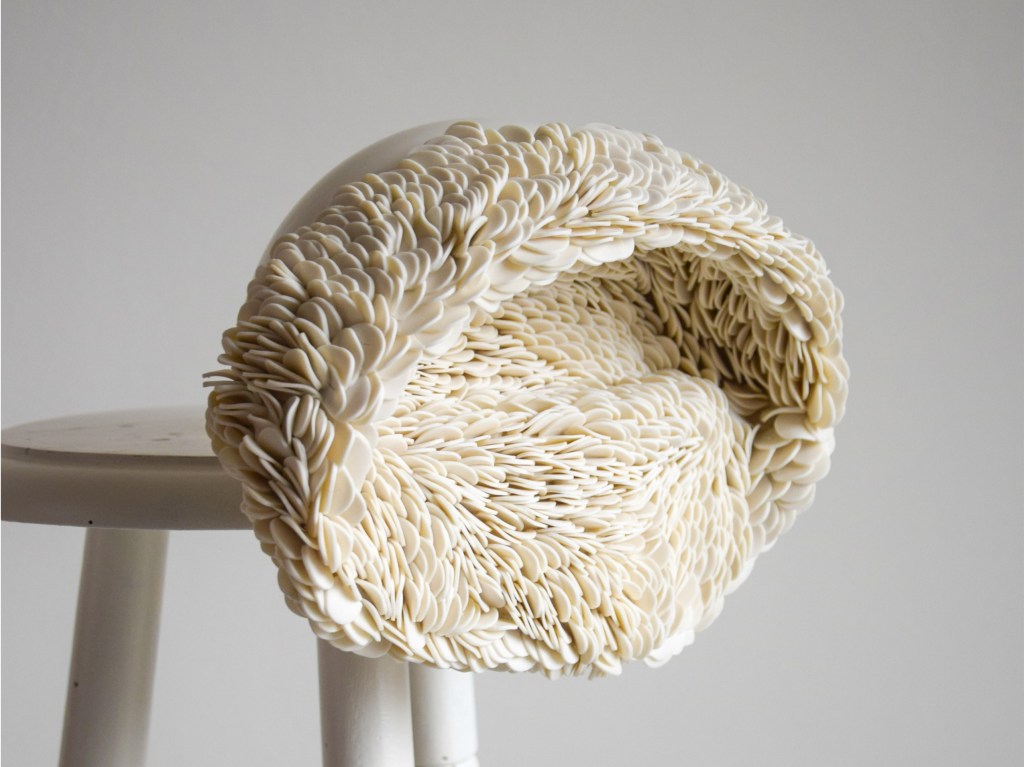
Ants Marching: the formula Silvia Granata has adopted for her recent production is a synthetic and icastic one. If on the metaphorical plane the ants signify small size and high mobility, it is above all the latter which offers a key to understanding the new challenge posed by the artist, which centres on the representation of movement. No easy task, given the static nature of the artist’s favourite material – shards of porcelain fixed by repeated cookings. Silvia Granata, though, has found effective formal expedients for her purposes: first of all, she has carefully chosen the axes of her vortex-like elements, that is to say the physical pivots which irradiate the directions of her accumulated elements. A vortex-like disposition is traditional in artistic representation, as shown by such early realizations as the disposition of the satyr’s hair in one of the reproductions of Myron’s group of sculptures depicting Athena and Marsyas. But if the vortex of that sculptural group has a single axis, in Silvia Granata’s work there is an abundance of axes which multiply exponentially the focal points from which movement emanates.
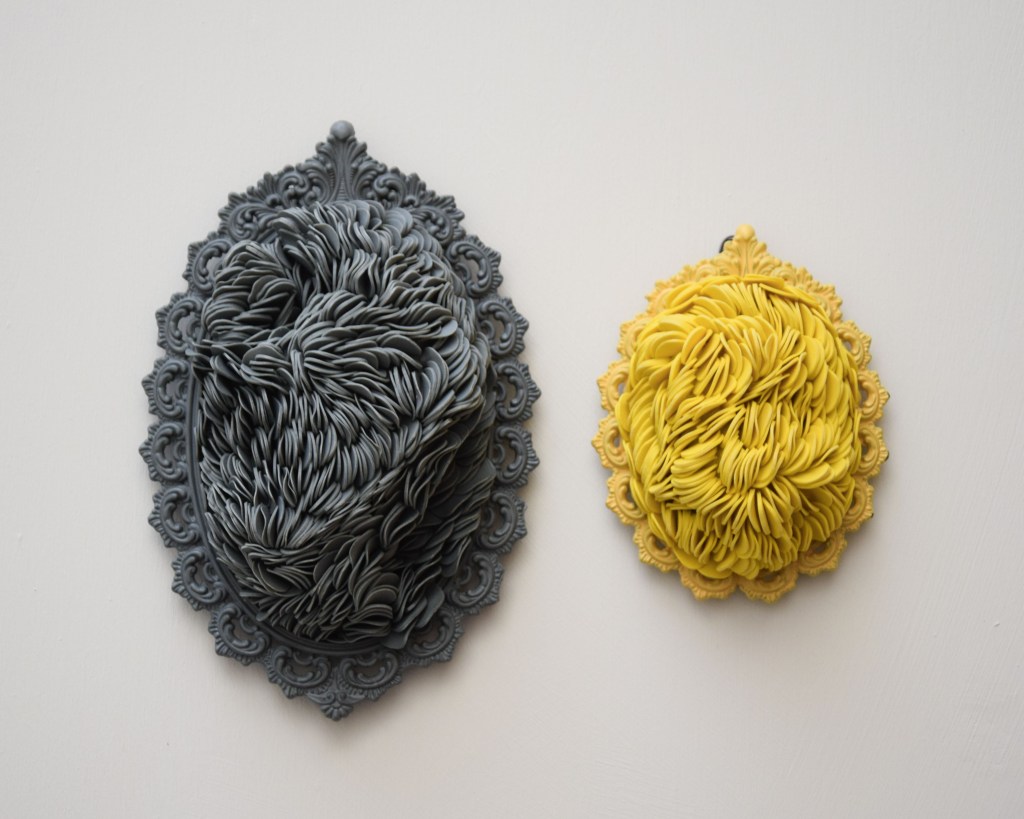
Another expedient is letting the porcelain elements overflow from the surfaces they are fixed on. If there is a precedent here in César’s expansions, the tactile realization here is completely different. The polyurethane flow is uncontrolled in the nouveau réalisme artist; here the movement is the outcome of Granata’s patient and painstaking mosaic disposition, particularly when the arrangement is conceived of in relation to an existing wall or frame. Here, in fact, is the real turning point of the artist’s new research – in the relationship between porcelain mosaic and destination surface. If the co-protagonist of her former work was the exposition space in a gallery or a museum, here the focus is on porcelain and objets trouvés. It does not matter whether those objects are precious eighteenth-century golden frames or simple everyday things. Each object is chosen as a memory-carrier, and the shards of porcelain become a map of our life paths, of carefully-planned itineraries constantly modified by setbacks which change their flow in a process of lively, incessant variation.
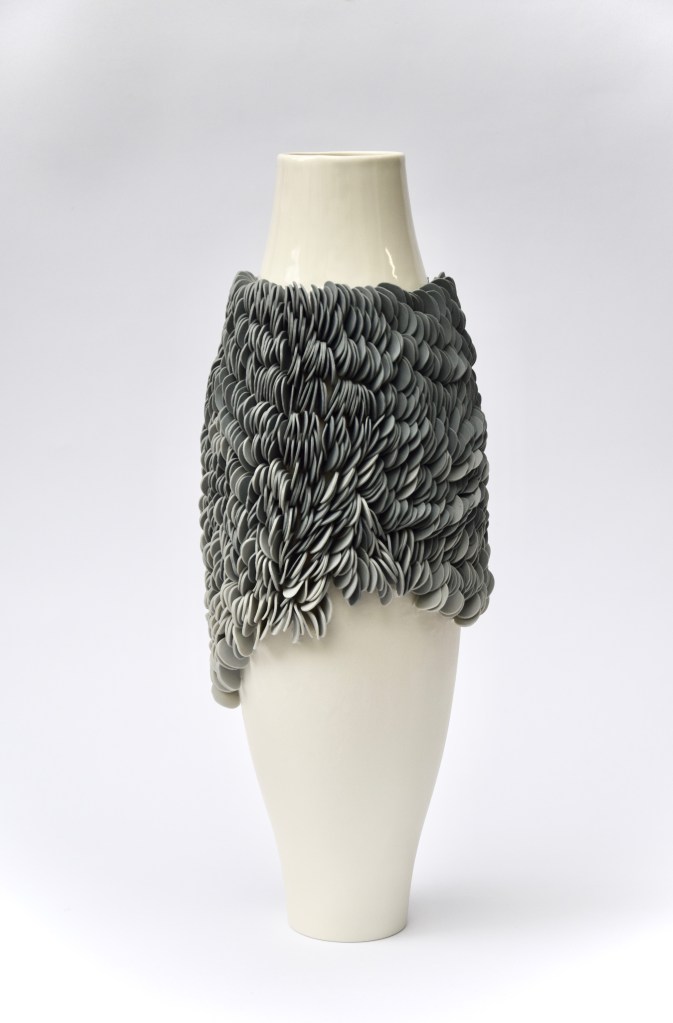
If in Serena Zanardi’s work the yellowed figures in the weathered photographs recover their three-dimensional nature; if for Rosana Antonelli porcelain becomes a support for the images themselves, blurred by memory and by the transposition in a new medium; in Silvia Granata the effect of layering is a function of the abstract, non-mimetic form, which requires the intervention of the viewer for its completion.
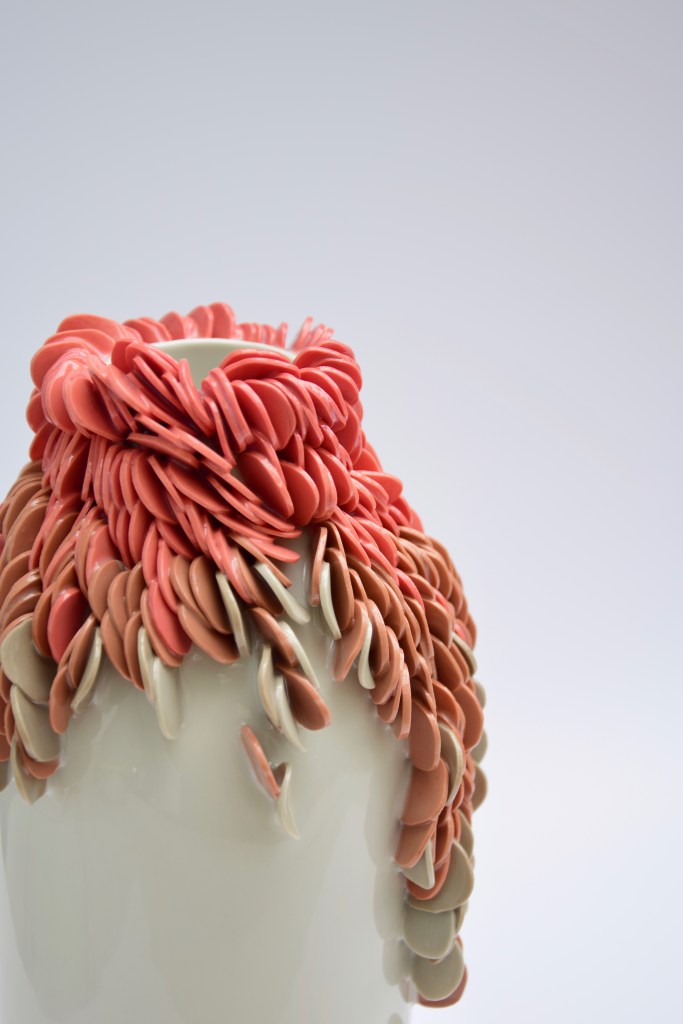
The fact that a work of art interrogates its audience in an act of communal reading is by now universally recognized: the use of colours, a minute care for each object and for the people who will experience this art, are all messages by means of which the artist is inviting us to observe the world of things and beings all around us. How distant from César’s style are these works in which live presences, real though infinitely small, walk away from the object, overflow from the frames or seem about to do so – and all to catch our attention. It is a painstaking realization which requires patient viewing, proposes a different relationship with the object and with all fellow creatures. We are just tiny ants, we know, but we are all marching, and our march is not without a cause.
Domenico Iaracà
Contemporary Italian Ceramic – CiC è il primo blog di ceramica diffuso, con uno sguardo alle tradizioni
ma soprattutto alle nuove correnti artistiche del panorama Italiano e non

